

The Deeper Spiritual Meaning of the Syamantaka Story — A Contemplative Guide
Most people know the Syamantaka episode as the reason we avoid looking at the moon on Ganesh Chaturthi. But when we sit with the story quietly, it reveals far more than a ritual rule. It becomes a mirror for the inner life — the pain of being misunderstood, the jewel as consciousness, the 28-day battle of self-recognition, and the mantra as pure truth-telling.

Most people know the Syamantaka episode as the reason we avoid looking at the moon on Ganesh Chaturthi. But when we sit with the story quietly, it reveals far more than a ritual rule.
Most people know the Syamantaka episode as the reason we avoid looking at the moon on Ganesh Chaturthi. But when we sit with the story quietly, it reveals far more than a ritual rule. It becomes a mirror for the inner life.
1. The Nature of False Accusation (Mithya Dosha)
Mithya dosha is not merely an external event. Spiritually, it represents the deepest form of suffering the ego can experience: being seen wrongly by the world while knowing the truth within.
Even Lord Krishna — the complete incarnation — allowed this experience to touch him. This is deliberate. The tradition is telling us that no one is above the pain of being misunderstood. The difference lies in how one responds.
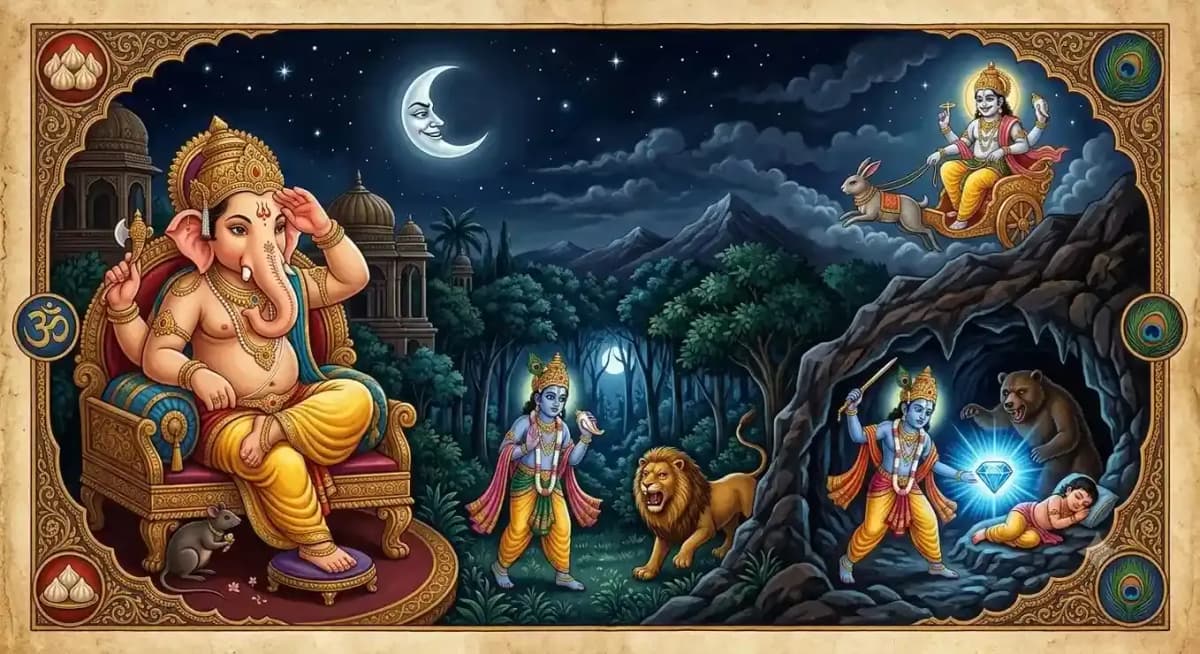
Krishna did not defend himself with arguments. He did not gather supporters. He did not become bitter. He simply walked into the forest to discover the truth.
Spiritual teaching: When false blame comes, the higher path is not self-justification. It is the silent, determined search for what is real.
2. The Jewel as a Symbol of Inner Light
The Syamantaka is not just a physical gem. In the language of the heart, it represents the light of pure consciousness or the true Self.
- When held with generosity, it multiplies abundance.
- When held with possessiveness, it brings destruction.
Satrajit's tragedy began the moment he refused to share the jewel. Krishna's grace began the moment he returned it without attachment.
Spiritual teaching: Whatever divine gift we receive — talent, beauty, wealth, spiritual insight — becomes a blessing only when we hold it lightly. The moment we clutch it as "mine," the same gift turns into a source of conflict.
3. The Twenty-Eight Day Battle: The Length of Inner Work
Krishna fought Jambavan for twenty-seven days and only on the twenty-eighth day was recognition born.
This is not random storytelling. Twenty-eight is the number of a complete lunar cycle. The battle lasts exactly as long as it takes for the moon to return to itself.
Spiritual teaching: Inner transformation cannot be rushed. The ego (Jambavan in his unrecognised state) will fight the higher Self for a full cycle of time. Only when exhaustion comes does recognition arise: "You were Rama. You are Krishna. You were always the same."
4. The Mantra as Pure Truth-Telling
The Syamantaka Mantra is unique in Hindu tradition. It contains no praise of God, no request, no surrender formula. It is simply a father telling his crying child the exact sequence of events:
The lion killed Prasena. Jambavan killed the lion. Do not cry. This jewel is already yours.
This is the highest form of spiritual speech — speech that restores reality without drama.
Spiritual teaching: When the mind is disturbed by fear or false stories, the most powerful medicine is calm, precise truth. Not positive thinking. Not denial. Simply: "This is what actually happened."
5. The Moon as the Mind
In yogic symbolism, the Moon represents the mind (manas).
On the night of Ganesh Chaturthi the mind is especially restless and reflective. Looking at the outer moon at that moment is seen as looking too deeply into the fluctuating mind when it is most prone to projection and misunderstanding.
The remedy is not to suppress the mind, but to bring it back to the clear light of Ganesha — the principle of pure intelligence that exists before the mind begins to create stories.
6. The Final Teaching of the Story
Notice how the story ends:
- Krishna returns the jewel.
- He accepts Jambavati and Satyabhama.
- He performs the worship of Ganesha with full devotion on the next Chaturthi.
There is no residue of bitterness. No "I was right and you were wrong." Only restoration and renewed worship.
Ultimate spiritual message: Even the experience of being falsely accused can become an offering if we allow it to purify attachment, deepen our search for truth, and return us to the feet of the Divine with greater sincerity.
Contemplative Practice
If you have seen the moon today, or if you carry any feeling of being misunderstood in life, sit quietly and recite the mantra slowly three times:
Siṁhaḥ prasenam avadhīt · siṁho jāmbavatā hataḥ · sukumāraka mā rodīḥ · tava hyeṣa syamantakaḥ
After the third repetition, place your hand on your heart and say inwardly:
Whatever is truly mine can never be taken. Whatever is not mine was never meant to stay. I rest in the truth.
This is the living spirit of the Syamantaka story.
May Lord Ganesha, the remover of every inner obstacle, and Lord Krishna, the revealer of truth, bless every seeker who reads these words with clarity, fearlessness, and deep peace.
Ganpati Bappa Morya. Krishna sharanam mama.
You might also like
Who Made Ganesh Chaturthi a Public Festival? Tilak, 1893, and the History of Sarvajanik Ganeshotsav
Sankashti Chaturthi Moon Rules: Why You Must See the Moon (and Break the Fast)

Ganesh Visarjan in Europe 2026: Country-Wise Rules & Eco-Friendly Guide